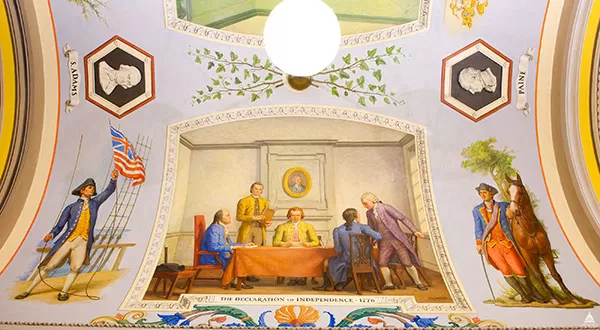
Allyn Cox (1896-1982) is the artist who created the initial designs for three corridors on the first floor of the U.S. Capitol's House wing: the Hall of Capitols, the Great Experiment Hall, and the Westward Expansion Corridor. Together, they are commonly referred to as the "Cox Corridors."

Cox painted the Hall of Capitols, assisted by Clifford Young and John Charles Roach. He completed the Great Experiment Hall just before his death, assisted by Young, who also designed and painted many of the portraits. They were assisted by Sally Price Ross, Everett Molinari and Martin Dehnell. EverGreene Painting Studios, Inc., led by Jeff Greene, then revised Cox's designs for the Westward Expansion Corridor and executed them in the 1990s.

The tools, supplies and sketches seen below offer a glimpse into the meticulous craft behind some of the U.S. Capitol's most recognizable murals.

Measuring Tools

Image
Objects used for measuring.
Photo by
James Rosenthal
Image
Young and Ross attaching a finished cartoon to a ceiling vault, 1978.
Photo by
Harry Burnett

After thorough surface preparation, canvas was applied to the walls and ceilings on top of the plaster, and a base coat of white paint was applied before attaching cartoons, or large preparatory drawings of the murals.

The tools in the image above are what the artists likely used to place centering lines, including a plumb line in the metal cup, which allowed accurate placement of the cartoons on the canvased areas.

Pouncing Tools

Image
Young and Roach during the pouncing process, 1973.
Photo by
Harry Burnett
Image
Pouncing supplies.
Photo by
James Rosenthal
Image
Young during the pouncing process, 1973.
Photo by
Harry Burnett

The artists transferred the designs from the full-size cartoons to the canvas by means of pouncing (applying powdered charcoal through perforations in the cartoons). The murals were then executed in oil paint.

After the cartoons were pounced, the artists would outline the images, then build up those outlines and add layers of color on each figure, landscape and architectural form.

Painting Supplies

Image
Image
Image
A variety of brushes, oil paint tubes, canisters and palette knives, and one of Cox's palettes.
Photos by
James Rosenthal

Key oil colors used for the project include:

  1. Yellow Ochre
  2. Cadmium Yellow
  3. Cadmium Red
  1. Cobalt Blue
  2. Cerulean Blue
  3. Viridian
  1. Burnt Sienna
  2. Raw Umber
  3. Mars Black

Outlining was done with Terre Verte, and Flake White was used throughout.

Additional Tools

Image
Image
A slide viewer, magnifying glass and box of drafting tools.
Photos by
James Rosenthal

A slide viewer and magnifying glass would have been used to provide close-up views of archival images that were sources for the scenes and people depicted in the murals. Drafting tools were used to create sketches, larger cartoons, and other preparatory materials with detail and accuracy.

The Work in Progress

Image
Image
Young, Roach and Cox painting the east corridor, 1973.
Photos by
Harry Burnett

As Cox worked on initial sketches, he made charcoal studies of the main figures. In line with his academic training, which emphasized a traditional way of figure drawing, he worked from models and made both nude and costumed sketches of what he called "the important figures." Cox also did studies for many of the other elements in the scenes.

While working through various elements and iterations, different pieces of paper could be pinned together to approximate the appearance of the finished mural.

Image
Image
Image
Image
"The Declaration of Independence, 1776" scene from The Great Experiment Hall of Cox Corridors.

"The Declaration of Independence, 1776" from rough sketch to detailed cartoon to finished mural.

The project materials in this collection stand as tangible reminders of the artistry and dedication that shaped the Cox Corridors. By preserving these objects, the Architect of the Capitol helps keep the story of these artists alive and reminds us that even the grandest artwork starts with simple tools, steady hands and a lot of creativity.

Add a new comment

The content of this field is kept private and will not be shown publicly.

Plain text

  • No HTML tags allowed.
  • Lines and paragraphs break automatically.
  • Web page addresses and email addresses turn into links automatically.

Our Stories

Recent Articles

Public Notice

Celebrate America 250 at the U.S. Capitol

Join us July 2-4, 2026, for our celebration! From 9:30 a.m.-3:30 p.m. we will have free family-friendly events, interactive experiences and lots of patriotic fun.
History & Discoveries

Capitol Extra! Magna Carta Replica and Display

Our Curator, Dr. Michele Cohen, is in the Capitol Crypt for the Magna Carta's anniversary. This entire display was made in England by artist Louis Osman, who had also crafted the crown for the investiture of Prince Charles.